
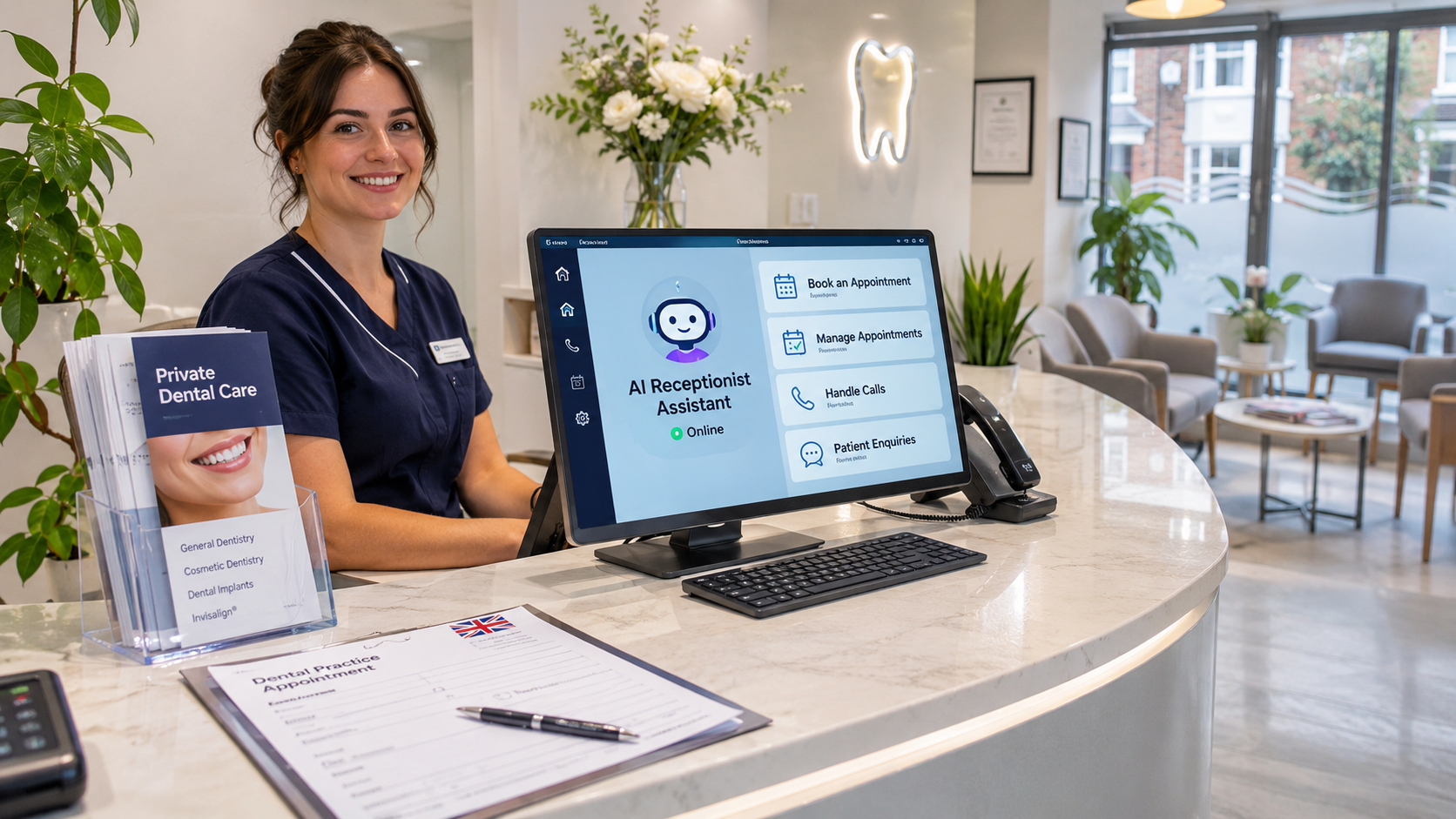
AI Receptionist for Dental Practices: The Complete UK Guide (2026)
By Rohan Morris, AI Advisers
A dental practice lives and dies by its appointment book. Every missed call is a missed appointment. Every unanswered enquiry is a patient who books with the practice down the road. And yet most UK dental practices are still relying on a single receptionist — or a small team — to handle every inbound call, web enquiry, and appointment request, often while simultaneously managing a busy waiting room.
This guide covers everything UK dental practice owners and practice managers need to know about AI receptionists: what they do, what they cost, how they integrate with dental practice management software, and what to look for when choosing one.
The problem: UK dental practices miss too many calls
Research consistently shows that UK dental practices miss between 30% and 40% of inbound calls during surgery hours. The reasons are predictable:
- The receptionist is with a patient at the desk
- The phone rings during lunch or at the end of the day
- The practice is closed but a patient is trying to book
- Multiple calls arrive simultaneously
Each missed call represents a lost appointment. For a practice charging £80–£200 per appointment, missing 10 calls a week is £40,000–£100,000 in lost revenue per year — before accounting for the patients who simply register elsewhere.
An AI receptionist solves this problem by answering every call, every time, regardless of what else is happening in the practice.
What is an AI receptionist for a dental practice?
An AI receptionist is a software system that handles inbound calls and web enquiries on behalf of your practice. It uses natural language processing to understand what a patient wants, and responds in a natural, conversational way — booking appointments, answering common questions, taking messages, and escalating urgent calls to a human.
For dental practices, a well-configured AI receptionist can handle:
- New patient registration enquiries — explaining NHS vs private options, registration availability, and next steps
- Appointment booking — checking availability and booking directly into your practice management system
- Appointment reminders and confirmations — reducing DNA (did not attend) rates
- Routine enquiries — opening hours, directions, parking, payment options, treatment costs
- Emergency triage — identifying genuine dental emergencies and escalating to a human or providing NHS 111 guidance
- Out-of-hours handling — taking messages and booking callbacks when the practice is closed
What it does not do: clinical triage, prescription queries, or anything requiring a qualified clinician. These are always escalated to a human.
How does an AI receptionist integrate with dental practice management software?
This is the question most practice managers ask first — and rightly so. An AI receptionist that cannot write into your appointment book is just an expensive answering machine.
The leading UK dental practice management systems — Dentally, SOE Exact, Carestream Dental, and R4 — all offer API access or integration pathways. The level of integration varies:
| System | Integration level | What the AI can do | |--------|------------------|--------------------| | Dentally | Full API | Read availability, book appointments, update patient records | | SOE Exact | API + webhooks | Read availability, book appointments | | Carestream Dental | Limited API | Read availability; booking requires human confirmation | | R4 | Via middleware | Read availability; booking via third-party connector |
For practices on Dentally, full two-way integration is achievable — the AI can check real-time availability and book directly. For practices on other systems, the AI typically reads availability and creates a booking request that the receptionist confirms, which still saves significant time.
If your practice management system is not listed above, ask any AI receptionist provider whether they have an integration or can build one. Most reputable providers will be honest about what is and is not possible.
What does an AI receptionist cost for a dental practice?
Pricing for AI receptionists varies significantly depending on the provider and the level of integration. Typical UK pricing in 2026:
| Tier | What you get | Monthly cost | |------|-------------|-------------| | Basic | Call answering, message taking, FAQ responses | £150–£300/month | | Standard | Above + appointment booking integration | £300–£600/month | | Premium | Above + full PMS integration, custom voice, analytics | £600–£1,200/month | | Enterprise | Multi-site, custom integrations, dedicated support | £1,200+/month |
For a single-site NHS or mixed practice, a Standard tier solution at £300–£600/month is typically the right starting point. The ROI calculation is straightforward: if the AI recovers two additional appointments per week at an average of £120 each, that is £960/month in recovered revenue against a £400/month cost.
The ROI case for dental practices
Let us work through a realistic example for a mixed NHS/private practice:
Current situation:
- 40 inbound calls per day
- 35% missed call rate = 14 missed calls per day
- 30% of missed calls would have booked = 4.2 appointments per day
- Average appointment value: £95 (blended NHS/private)
- Lost revenue per day: £399
- Lost revenue per month (22 working days): £8,778
With an AI receptionist:
- Missed call rate drops to 5% (2 missed calls per day)
- Additional appointments recovered: 3.6 per day
- Additional revenue per month: £7,524
- AI receptionist cost: £450/month
- Net monthly gain: £7,074
Even with conservative assumptions, the ROI case for most UK dental practices is compelling. The payback period is typically less than one month.
CQC compliance and patient data considerations
This is a critical area for UK dental practices. Any AI system that handles patient data must comply with:
- UK GDPR — patient data must be processed lawfully, with appropriate consent and security measures
- CQC Key Question 5 (Well-led) — practices must demonstrate appropriate governance of technology systems
- ICO guidance on AI — the Information Commissioner's Office has published specific guidance on AI in healthcare settings
- NHS Data Security and Protection Toolkit — for NHS-contracted practices
When evaluating AI receptionist providers, ask specifically:
- Where is patient data stored? (UK-based servers are strongly preferable)
- Is the system ISO 27001 certified?
- Do they have a Data Processing Agreement (DPA) ready to sign?
- Have they been used in CQC-registered healthcare settings before?
- Can they provide evidence of compliance with the NHS DSPT?
A reputable provider will answer all of these questions clearly. If they cannot, do not proceed.
What to look for when choosing an AI receptionist for your dental practice
1. Healthcare-specific training
A generic AI receptionist trained on retail or hospitality data will not understand dental terminology, NHS vs private distinctions, or the specific language patients use when describing dental symptoms. Look for a provider with demonstrable experience in healthcare or dental specifically.
2. Natural, human-sounding voice
Patients calling a dental practice are often anxious. A robotic or stilted AI voice will increase anxiety and reduce trust. Listen to demo calls before committing — the voice quality matters more in healthcare than in most other sectors.
3. Escalation handling
The AI must know when to hand off to a human. Dental emergencies, distressed patients, complex clinical questions, and complaints must all be escalated immediately. Ask the provider to walk you through their escalation logic.
4. Practice management system integration
As covered above, the depth of PMS integration determines how much time the AI actually saves. A system that cannot write into your appointment book requires your receptionist to manually action every booking — which defeats much of the purpose.
5. Customisation and brand voice
Your practice has a tone — warm, professional, reassuring. The AI should reflect that. Ask whether you can customise the script, the voice, and the responses to match your practice's personality.
6. Analytics and reporting
A good AI receptionist provides data: call volumes, peak times, common enquiry types, booking conversion rates. This data is valuable for staffing decisions and marketing.
How AI Advisers implements AI receptionists for UK dental practices
AI Advisers has implemented AI receptionist systems for dental practices across the UK, including practices on Dentally, SOE Exact, and R4. Our implementation process:
Week 1: Discovery and configuration We map your current call flows, identify the most common enquiry types, and configure the AI to match your practice's voice and processes. We set up the PMS integration and test it against your live appointment book.
Week 2: Soft launch The AI handles a subset of calls — typically out-of-hours and overflow — while your team monitors performance. We refine the responses based on real call data.
Week 3–4: Full deployment The AI handles all inbound calls, with your receptionist focusing on in-practice patient care and complex enquiries. We provide a dashboard showing call volumes, booking rates, and patient satisfaction signals.
Ongoing: Optimisation We review performance monthly and update the AI's responses as your services, pricing, or processes change.
We offer a 28-day free trial for dental practices — no contract, no card required. Claim your free trial →
Common concerns from dental practice managers
"Our patients are older and won't want to talk to a machine"
This is the most common objection — and the data does not support it. In our experience, patients over 60 adapt quickly when the AI is natural-sounding and helpful. What patients dislike is not talking to an AI; it is talking to a bad AI. A well-configured system with a warm, clear voice is accepted by the vast majority of patients within the first week.
"What if a patient has a dental emergency?"
Emergency escalation is built into every AI receptionist we deploy. When a patient describes symptoms consistent with a dental emergency — severe pain, swelling, trauma, bleeding — the AI immediately offers to connect them to a human, provides the NHS 111 number, and flags the call for urgent callback. No emergency call is handled by the AI alone.
"We already have a receptionist — won't this replace them?"
No. The AI handles the calls your receptionist cannot get to — the overflow, the out-of-hours, the simultaneous calls. Your receptionist focuses on the patients in front of them, the complex enquiries, and the tasks that genuinely require a human. Most practices find that their receptionist's job satisfaction improves because they are no longer constantly interrupted by the phone.
"What about NHS contract compliance?"
AI receptionists do not affect your NHS contract. They are a patient communication tool, not a clinical system. Your NHS obligations — appointment availability, clinical governance, CQC registration — are unchanged. If you have specific concerns about your contract, we recommend checking with your NHS England regional team.
Frequently asked questions
Can an AI receptionist book NHS dental appointments?
Yes, if it is integrated with your practice management system. The AI checks your real-time availability and books the appointment directly. For NHS appointments, it can also explain the NHS charge bands and confirm the patient's exemption status if required.
Does an AI receptionist work out of hours?
Yes — this is one of its most valuable features for dental practices. The AI answers calls 24/7, takes messages, books appointments into the next available slot, and handles urgent enquiries by providing NHS 111 guidance and flagging the call for a morning callback.
How long does it take to set up an AI receptionist for a dental practice?
With a provider experienced in dental, setup typically takes 5–10 working days. This includes PMS integration, voice configuration, script customisation, and testing. AI Advisers typically has practices live within 7 working days.
Will the AI understand dental terminology?
A healthcare-trained AI receptionist will understand common dental terms — check-up, scale and polish, extraction, crown, root canal, whitening, Invisalign, and so on. It will not attempt to provide clinical advice or interpret symptoms beyond basic emergency triage.
What happens if the AI cannot answer a question?
The AI is configured with a fallback: if it cannot confidently answer a question, it takes the patient's details and promises a callback from a human team member. It never guesses or provides inaccurate information.
Is an AI receptionist GDPR compliant for a dental practice?
It can be — but compliance depends on the provider. You must ensure the provider has a signed DPA, stores data in the UK or EEA, and meets the ICO's requirements for AI in healthcare. AI Advisers' systems are UK-hosted, ISO 27001 aligned, and come with a full DPA as standard.