
If you've heard the term AIOS and wondered what it actually means for your business — this is the plain-English answer.
You opened the laptop to do one job. Six tabs, three notifications and a copy-paste between two apps later, you still haven't started it. Modern business runs on more tools than any one person can hold in their head, and the admin they throw off quietly eats the week. An AIOS is the fix — one system that holds the whole business and does the repeatable work for you.
What is an AIOS?
An AIOS (AI Operating System) is a single dashboard with a team of AI agents behind it that do real business work — replying to leads, researching markets, drafting copy, building decks and creating content — backed by a persistent "second-brain" memory that learns your business and gets sharper over time. Unlike a chatbot, an AIOS acts on tasks. Unlike SaaS, you own it outright.
The term AIOS is gaining traction fast because it describes something genuinely new: not another AI chat tool, but an operating layer that sits across your whole business and runs the repeatable parts of it.
TL;DR
- AIOS = one screen, a whole AI workforce. A team of AI agents that do the work — research, copy, video, decks — not just answer questions.
- It remembers. A second-brain memory holds your goals, clients and past work, so you never re-brief it. ChatGPT forgets you the moment you close the tab.
- Three people feel it fastest: small business owners drowning in admin, multi-client directors juggling several businesses, and content creators shipping at scale.
- You own it forever. Installed and tailored for you, running on your own machine — no code, no jargon, no monthly SaaS rent.
- The window is now. Gartner expects 40% of enterprise apps to carry task-specific AI agents by 2026, up from under 5% in 2025 (Gartner, 2025).
Why "another AI tool" isn't the answer
Most business owners have tried AI. They opened ChatGPT, got a clever answer, and then hit the wall: it forgets everything, it only talks (it never does), and it lives in yet another tab alongside the twenty they already juggle.
That gap is expensive. The average entrepreneur spends 36% of their working week on small administrative tasks like invoicing, data entry and scheduling (Forbes, 2023). In the UK, Sage found small businesses lose 24 days a year to financial admin alone — "13 months of work for 12 months of pay" (Sage, 2025).
An AIOS closes that gap because it's built around three things a chatbot isn't: agents that act, a memory that persists, and one screen that shows it all.
What makes an AIOS different from other AI tools?
Think of the difference between a calculator and a finance team. One answers when you ask. The other owns the outcome. Here's how an AIOS compares with the tools most businesses reach for first:
| | ChatGPT / chatbot | Automation tools (Zapier etc.) | AI agency (retainer) | AIOS | |---|---|---|---|---| | Does the work autonomously | No — answers only | Rigid, breaks on edge cases | Yes, but you pay forever | Yes — agents action tasks | | Remembers your business | Forgets each session | No memory | In someone's head | Second-brain memory, persists | | One place to see everything | No | No | Reports only | One dashboard | | Ownership | Rented subscription | Rented subscription | You never own it | Owned outright, on your machine | | Data location | Vendor servers | Vendor servers | Vendor servers | Your device |
Chatbots aren't the problem here — they were simply never designed to run a business. An AIOS was.
What's actually inside the AIOS?
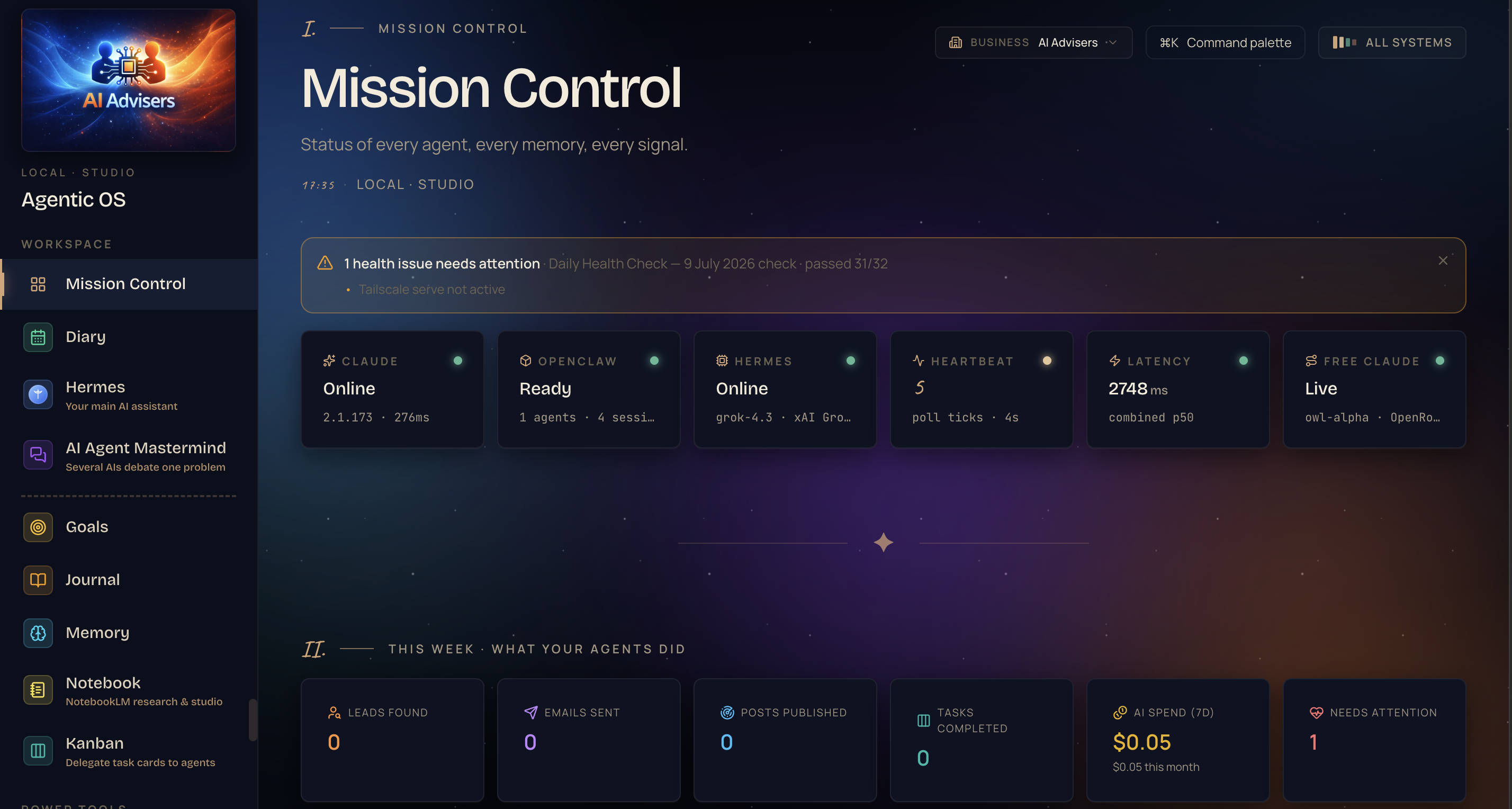
This isn't theory. Below is the real toolset that ships on the AI Advisers AIOS dashboard — the same system we run our own business on, which is why every demo is the live product rather than a slide.
| Tool on the AIOS dashboard | What it does for you | |---|---| | Chat + Agents | Brief an agent in plain English; it plans and completes the task, not just answers | | Deep Research | Market, audience and competitor dossiers, gathered and written up for you | | Niche Map | Sub-niche, keyword and offer-angle maps to find where demand actually is | | Builder/Judge Loops | Drafts ad copy, emails and landing pages, then an AI "judge" refines them until they pass | | Studio | Generates images and video from a prompt, on brand | | Thumbnail Studio | Click-worthy thumbnails for video and social | | Deck → Gamma | Turns research into a finished, designed presentation | | Blog Posts | SEO/AEO articles — this very article was drafted by the AIOS | | Voice + Phone agent (premium) | Call or text the AIOS; it actions the task in the background and reports back | | Business switcher | Sets the active client so every output lands in the right place, in the right voice | | Memory | A second brain that remembers goals, clients and everything it has built |
Because the AIOS is model-agnostic, it always reaches for the best available AI brain for the job — so you're never locked into one vendor or left behind when a sharper model launches. And it runs a Daily Health Check on itself, so you can see at a glance that everything's working.
How does an AIOS help a small business owner?
If you're a small business owner, the enemy is the "small-business squeeze": you're buried in admin instead of doing the work only you can do. An AIOS takes the repeatable load off your plate.
- It never misses a lead. Speed is money here. A landmark Harvard Business Review audit of 2,241 companies found firms that contacted a new lead within an hour were "nearly seven times as likely to qualify the lead" as those that waited just 60 minutes longer (HBR, 2011). An AIOS agent that replies in minutes, day or night, turns that statistic into revenue.
- It clears the admin. Inbox triage, follow-ups, scheduling and first-draft quotes are handled in the background — and because the AIOS dashboard auto-invokes the right skill ("draft a follow-up email" quietly calls the email-drafter), you don't hunt for the tool, you just ask.
- It grows without hiring. You add capacity without adding headcount, payroll or onboarding.
- It runs from your pocket. On the premium tier you can call or text the AIOS from a job or the road — "add a follow-up with that client and draft the quote" — and it's actioned and waiting on your dashboard by the time you're back.
Example: an owner finishes a site visit, phones the AIOS, and by the time they're back at the van the Builder/Judge Loop has produced an on-brand quote email and the memory has logged the job against that customer.
How does an AIOS help a multi-client business director?
If you run operations across several businesses or clients, your real problem is context-switching. Every client has different goals, brand rules and history — and holding all of it in your head (or across a dozen folders) is where things slip.
An AIOS is multi-business aware. Flip the Business switcher at the top of the AIOS dashboard and everything re-points to that client: Deep Research, Niche Maps, Loops, decks and blog posts all save to their workspace and speak in their voice, grounded in their profile and memory.
- One AIOS command centre for every client, instead of separate stacks and logins.
- No re-briefing. The AIOS memory carries each client's context between tasks, so agent number two picks up where number one left off.
- Client-ready deliverables, fast. Deep Research → Deck → Gamma turns a raw market dossier into a designed pitch for a client meeting in one flow.
- Approval gates so a human signs off the decisions that matter before anything goes out.
This is where the market is heading, too. McKinsey reports that nearly two-thirds of enterprises are already experimenting with AI agents — though fewer than 10% have scaled them to real value (Forbes, 2026). The directors who install a proper AIOS now are the ones who capture that value first.
How does an AIOS help a content creator?
For content creators, the bottleneck isn't ideas — it's production volume. An AIOS ships a full creative suite as part of the operating system, all fed by the same memory so your brand voice stays consistent across everything.
- Research to publish, in one AIOS flow. Niche Map finds the angle, Deep Research backs it with evidence, Blog Posts writes the SEO/AEO article, and Studio plus Thumbnail Studio produce the header image, faceless video and thumbnail — no copy-pasting between six apps.
- On-brand by default. Every asset is grounded in your AIOS profile, so it sounds and looks like you, not like generic AI.
- Refined, not just generated. The Builder/Judge Loop runs each caption or script past an AI critic and rewrites until it passes — so what lands in your AIOS dashboard is a strong draft, not a first stab.
- A fraction of the cost per asset. Because the whole suite drafts, refines and repurposes in one place, the cost of producing each article, video and thumbnail drops sharply — so publishing weekly, or even daily, finally adds up on the maths.
- Repurpose at scale. One idea becomes an article, a thread, a script, a video and a set of pins.
Visual suggestion: A split-screen graphic — "20 tabs" on the left, "1 AIOS dashboard" on the right. Alt text: Comparison showing a cluttered browser with twenty tabs beside a single clean AIOS dashboard. Caption: App fatigue is a hidden tax on small businesses. An AIOS replaces the stack.
Is now the right time to install an AIOS?
Yes — and the data is blunt about the window. Gartner predicts 40% of enterprise applications will include task-specific AI agents by the end of 2026, up from less than 5% in 2025 (Gartner, 2025).
But there's a catch worth being honest about: Gartner also warns that over 40% of agentic AI projects will be cancelled by the end of 2027, mostly due to unclear value and poor implementation (Gartner, 2025). Translation: the technology works — most rollouts fail. That's exactly why a done-for-you AIOS, installed and tailored by people who run the same system themselves, beats a DIY experiment.
Visual suggestion: A simple three-step diagram — Demo → Install & tailor → Own it forever. Alt text: Three-step process for getting an AIOS: free demo, installation and tailoring, then ownership. Caption: No code, no jargon — plain-English handover, and you keep it.
What an AIOS gives each role, at a glance
| Role | Biggest drain today | What the AIOS does | Tools they'll live in | |---|---|---|---| | Small business owner | Admin & missed leads | Replies fast, clears admin, grows without hiring | Voice/phone agent, auto-skills, Loops | | Multi-client director | Context-switching | Routes work per client, remembers each one | Business switcher, Memory, Deck → Gamma | | Content creator | Production volume | Research-to-publish suite, on-brand at scale | Niche Map, Studio, Thumbnail Studio, Blog Posts |
Conclusion — your own AIOS, installed for you
An AIOS works like an operating system for your business: agents that act, a memory that never forgets, and one dashboard that finally replaces the twenty tabs. That's a different job from a chatbot, and it shows up in your week. Owners get their time back, directors get one AIOS command centre for every client, and creators get a production line that sounds like them.
The agents are ready. The only question is whether your AIOS is installed and working for you — or still sitting in a browser tab.
Ready to see what your AIOS would actually do? Get your free AI Workflow Blueprint — a plain-English map of the exact tasks an AIOS could take off your plate this month.
👉 Get my free AI Workflow Blueprint
Frequently asked questions about AIOS
What does AIOS stand for?
AIOS stands for AI Operating System — a single dashboard with a team of AI agents behind it that do real business work autonomously, backed by a persistent memory that learns your business. It's installed, tailored and owned, not rented.
How is an AIOS different from ChatGPT?
ChatGPT answers questions, then forgets you when you close the tab. An AIOS acts on tasks — replying to leads, researching, drafting copy, building decks and content — and remembers your goals, clients and past work across every session, all on one AIOS dashboard you own.
What tools come with the AI Advisers AIOS?
The AIOS dashboard ships with Chat + Agents, Deep Research, Niche Map, Builder/Judge Loops for copy, Studio for image and video, Thumbnail Studio, Deck → Gamma export, an SEO Blog Posts writer, a Business switcher for multiple clients, second-brain Memory, and an optional voice and phone agent on the premium tier.
Do I need to be technical to use an AIOS?
No. A done-for-you AIOS is installed and tailored for you, then handed over with plain-English training. There's no code and no jargon — you brief the AIOS agents the way you'd brief a colleague, including by voice on the premium tier.
Who benefits most from an AIOS?
Small business owners buried in admin, multi-client business directors juggling several businesses, and content creators producing at scale. Anyone whose week is eaten by repeatable work an AIOS agent can own gets the fastest return.
Is my data safe with an AIOS?
Yes — an AIOS runs on your own machine, so your data stays on your device rather than a vendor's servers. It also uses approval gates, so a human signs off the decisions that matter before anything goes out.
How quickly can an AIOS be installed?
The AIOS installation process is three steps: a free demo call, installation and tailoring to your business, then plain-English training. Because it's done-for-you, most of the setup work sits with the installer, not with you.
What is the cost of an AIOS for a small business in the UK?
AI Advisers offers two AIOS tiers: the Launchpad AIOS at £1,500 (one-off) and the Premium AIOS at £3,000 (one-off). Both are installed and tailored for you with no ongoing SaaS fees — you own the system outright.
Glossary
- AIOS (AI Operating System): A dashboard-based system of AI agents that do business work autonomously with persistent memory.
- AI agent: Software that takes a task from start to finish (not just answering), such as replying to a lead or drafting a quote.
- Second-brain memory: Persistent context — goals, clients, past work — that the AIOS remembers between tasks so you never re-brief it.
- Builder/Judge Loop: A pattern where one agent drafts and a second "judges" and refines the output until it meets the bar.
- Business switcher: The control that sets the active client so every AIOS tool saves to and speaks for the right business.
- Approval gate: A checkpoint where a human reviews and signs off an agent's output before it's actioned.
- Model-agnostic: Able to use whichever underlying AI model is best for a task, rather than being tied to one vendor.
Written by Rohan Morris of AI Advisers, an AI implementation consultancy that installs done-for-you AIOS solutions for UK small businesses. We run the same AIOS ourselves — every demo is the live system, not slideware, and this article was drafted on it.