
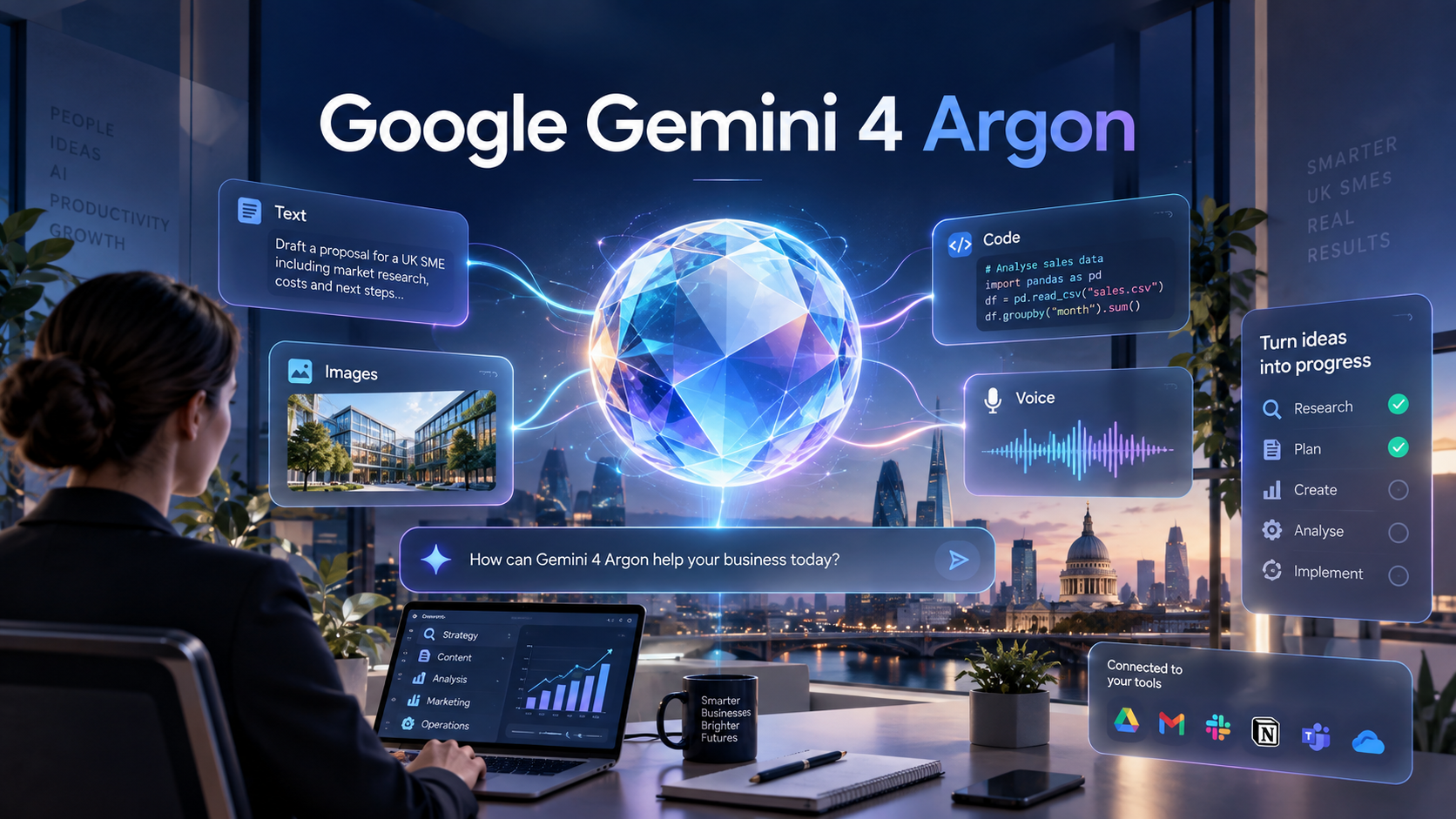
Gemini 4 Argon Access for UK SMEs
Gemini 4 Argon is Google DeepMind's new frontier AI model, announced on 30 September 2026 for complex coding, enterprise knowledge work and cybersecurity. Access is restricted to trusted testers through the Fairwind Program, so UK SMEs cannot use it directly yet, though its capabilities will filter into mainstream Gemini tools over time.
Gemini 4 Argon: Key Facts at a Glance
- Google DeepMind announced Gemini 4 Argon on 30 September 2026, led by SVP and Chief AI Architect Koray Kavukcuoglu (Google, 2026).
- Access is limited to the Fairwind Program — government cyber authorities, critical infrastructure operators, core technology platforms and academic defenders — not the general public (Google DeepMind, 2026).
- The model outputs up to 1 million tokens per run, up from 64,000 on earlier Gemini models, built for long-horizon tasks like full codebase migrations (Google, 2026).
- Introductory API pricing is $2 per million input tokens and $10 per million output tokens, rising to $4 and $20 once the introductory period ends (Google, 2026).
- 54% of UK SMEs were already actively adopting AI as of March 2026, up from 35% the year before (British Chambers of Commerce & Atos, 2026), so the gap between frontier capability and SME-ready tooling is closing fast.
What Is Gemini 4 Argon?
Gemini 4 Argon is Google DeepMind's latest frontier model, positioned for "complex, long-horizon professional tasks" rather than quick chat replies (Google, 2026). It was unveiled via Google DeepMind's own announcement on 30 September 2026, aimed squarely at software engineering, enterprise knowledge work (finance, legal, tax) and autonomous cybersecurity defence.
The headline technical change is a jump to a 1-million-token output limit — a sixteen-fold increase on earlier Gemini models — which lets the model work through an entire multi-step task, such as a large-scale C/C++-to-Rust migration, in a single run instead of being stitched together from short completions (Google, 2026).
Who Can Access Gemini 4 Argon Right Now?
Nobody outside a narrow group gets Gemini 4 Argon today. Access runs through the Fairwind Program, which Google DeepMind describes as giving "high-priority defenders early access to advanced models that help them build better defenses, before new threats arrive" (Google DeepMind, 2026).
Eligible organisations are limited to:
- Governments and national cyber authorities protecting public-sector networks
- Critical infrastructure operators in healthcare, telecoms, energy and financial services
- Core technology platforms securing software foundations used by others
- Academic institutions running defensive security research
Participants must show "a proven track record of ethical operations," pass background checks, enforce phishing-resistant multi-factor authentication, and restrict use to internal cybersecurity, incident response or penetration-testing teams (Google DeepMind, 2026). Security firm Wiz is the first named external partner, reportedly using Argon through its Scan for Good initiative to surface critical vulnerabilities in healthcare software that earlier models missed (tbreak, 2026). Google says its own teams are also running the model internally, and it is coordinating with the US government's voluntary pre-release access process before any wider rollout (tbreak, 2026).
What Can Gemini 4 Argon Actually Do?
Google's own benchmark disclosures give the clearest picture of where Argon is strongest:
| Area | Benchmark | Argon score | |---|---|---| | Coding / software engineering | DeepSWE v1.1 | 77.9% | | Vulnerability discovery & patching | CWE-bench v1 | 68% (joint first) | | End-to-end business task completion | AutomationBench | 51.3% | | Long-form video & chart understanding | LVBench | 91.7% |
Source: Google, 2026
Beyond raw scores, Google highlights concrete engineering wins: Argon has been used internally for large-scale C/C++-to-Rust conversions on codebases over 800,000 lines, and for autonomous memory optimisations across data centres that freed more than 300 TiB of memory (GadgetBond, 2026). On the security side, it ties for first place on CWE-bench v1 and is built with hardened defences against indirect prompt injection, a known weak point for agentic coding tools (GadgetBond, 2026).
Why Finishing the Job Matters More Than Raw Power
Here is the number worth sitting with: Argon scores 77.9% on a coding benchmark but only 51.3% on AutomationBench, which measures whether a model can complete an entire business function end to end, not just produce a plausible-looking answer (Google, 2026). That gap is the real story for any business evaluating a frontier model: a model can write excellent code or a strong first draft and still fail to deliver a finished, reliable workflow without close supervision.
This is exactly the distinction UK SME owners should apply when a vendor pitches a new "agentic" model. As Ideja Bajra, founder of Edvance AI, puts it: "The biggest benefit to using AI is speed and efficiency; automating your processes means you can reach clients faster" (Simply Business, 2026) — but speed only compounds value if the process actually finishes correctly, unattended, every time. That's the bar we use in our own workflow audit standard when assessing whether an automation is genuinely production-ready or just an impressive demo.
What Does Gemini 4 Argon Mean for UK SMEs?
Directly, very little — yet. Gemini 4 Argon is not available to UK SMEs through any consumer or standard business channel; it is confined to Fairwind Program cybersecurity partners (Google DeepMind, 2026). No UK SME is going to be running Argon in its finance or legal workflows this quarter.
Indirectly, the signal matters a great deal. AI adoption among UK SMEs climbed to 47% in September 2026, up from 22% the year before, with a further 13% planning to adopt within six to twelve months (Simply Business, 2026). Yet only 19% of those businesses describe themselves as "very confident" using AI day to day, and 44% of non-adopters cite security and privacy as their main barrier (Simply Business, 2026). Frontier models like Argon are being built first for exactly that confidence and security gap — autonomous vulnerability patching, hardened sandboxing, resilience to prompt injection — which means the tooling SMEs will eventually inherit should arrive safer, not just more capable.
The practical takeaway: don't wait for Argon-level power to show up in your everyday tools before deciding what you actually want automated. Most UK SMEs are better served today by clarifying what workflow automation actually looks like in their own operation, and lining up a small business automation plan now, so that when more capable models do reach standard business tiers, there's already a clear, audited process ready to plug them into.
Open Frontier Models vs Closed Ones: Where Argon Sits
Argon's restricted, invitation-only release is a deliberate contrast to the open-weight strategy some rivals are pursuing. We covered this trade-off recently when Moonshot released its open Kimi K3 model: open models let any business inspect, self-host and fine-tune, while Google's approach keeps its most capable model behind strict vetting until safety testing catches up with its capability. For a UK SME, the practical implication is the same either way — the model itself is only ever half the solution; the other half is the workflow and governance wrapped around it.
How Should a UK SME Prepare for Agentic AI Models Like Argon?
Three things are worth doing now, well before Argon-class capability reaches a tool your business can actually buy:
- Document the workflow, not just the task. Agentic models are judged on whether they finish a whole job unattended, so map the full process — inputs, exceptions, handoffs — the way we did for a compliance-critical airside pass workflow at Luton Airport, where the automation had to complete correctly every time, not just most of the time.
- Separate chat from workflow. A chatbot that drafts a good answer is not the same as an agent that reliably completes a business process; see how we drew that line in turning chatbot prompts into real workflows.
- Get an independent read on where automation will actually pay off before committing budget to any new model or platform. That's the single highest-leverage step for most SMEs right now — an AI readiness audit identifies which processes are worth automating first, rather than chasing whichever model made headlines this week.
Frequently Asked Questions
What is Gemini 4 Argon?
Gemini 4 Argon is Google DeepMind's frontier AI model, announced on 30 September 2026 for complex coding, enterprise knowledge work and autonomous cybersecurity defence, with a 1-million-token output limit (Google, 2026).
When was Gemini 4 Argon announced?
Google DeepMind announced Gemini 4 Argon on 30 September 2026, via its official X account and a companion post on the Google blog (Google DeepMind, 2026; Google, 2026).
Who can access Gemini 4 Argon right now?
Access is limited to the Fairwind Program: governments, critical infrastructure operators, core technology platforms and academic security researchers with a vetted track record. It is not available to the general public or most businesses (Google DeepMind, 2026).
How much will Gemini 4 Argon cost?
Introductory API pricing is $2 per million input tokens and $10 per million output tokens, rising to $4 and $20 after the introductory period, with a 95% discount on cached input tokens (Google, 2026).
Can UK SMEs use Gemini 4 Argon today?
No. Gemini 4 Argon is restricted to Fairwind Program partners. UK SMEs will likely gain access to its underlying capabilities indirectly, as they filter into standard Gemini API and Google AI Ultra tiers over time (Google, 2026).
What makes Gemini 4 Argon different from earlier Gemini models?
Its output limit rose to 1 million tokens from 64,000, letting it sustain reasoning through an entire multi-step task in one run, and it adds purpose-built defences against indirect prompt injection and autonomous vulnerability patching (Google, 2026).
Does a model like Gemini 4 Argon remove the need for a workflow audit?
No. Argon scores 77.9% on coding tasks but only 51.3% on end-to-end business task completion (AutomationBench), showing that raw model capability and a finished, reliable workflow are not the same thing (Google, 2026).
Should a UK SME change its AI strategy because of Gemini 4 Argon?
Not immediately, since direct access is closed. It is a useful signal to prepare: audit which workflows are worth automating now, so the business can adopt stronger models quickly once they reach standard business tiers.
Gemini 4 Argon Support for UK SMEs
Frontier models like Gemini 4 Argon make one thing clear: the race is no longer about who can write the most code or hold the longest context — it's about who can finish a real job without supervision. For UK SMEs, that means the groundwork done today — mapping workflows, tightening data handling, picking the right automation to start with — determines how much value the next wave of models actually delivers, whenever it reaches a tier your business can use.
AI Advisers is based in Milton Keynes and works with UK SMEs to audit, design and implement AI-driven workflow automation so they're ready to adopt stronger models as access widens. If you want a clear view of where automation would pay off first in your business, start with an AI readiness audit, or explore the AIOS platform and our Milton Keynes AI consultancy services.